> ## Documentation Index
> Fetch the complete documentation index at: https://docs.sumbios.ai/llms.txt
> Use this file to discover all available pages before exploring further.
# Ask O
> Ask about the people in your network in your own words, and get an answer drawn from what O remembers.
export const Annotated = ({src, alt, caption, markers = [], size}) =>
{markers.map(m =>
{m.n}
)}
{caption ? {caption} : null}
;
Ask O is where you ask about your network in plain words: who someone is, who can introduce you, what has changed. It is the first thing on **Home**, and you can open it from any page.
## When you would use it
Before a meeting, when you want the context on everyone in the room. When you need a warm way into a company or a fund. When you want to know who in your network knows a market you are entering. You ask the way you would ask a colleague who knows everyone you know.
## Where to find it
Select **Home** in the sidebar. The address is `/home`. On any other page, choose **Open Ask O** in the top bar to open it beside what you are doing; see [Open the Assistant from anywhere](/getting-started/assistant-anywhere).
| # | Element | What it does |
| - | - | - |
| 1 | **Ask O** | The conversation you are in. |
| 2 | **History** | Your earlier conversations. Filter them by time, and pin, rename or delete one. |
| 3 | **New chat** | Starts a fresh conversation, without carrying over the earlier one. |
| 4 | Message box | Type your question here. The hint reminds you: **Ask anything, @ to mention, / for commands**. |
| 5 | **Attach a supported document** | Adds a document for O to use in this conversation. |
| 6 | **Send message** | Sends your question. |
Under the box, O reminds you: **AI can make mistakes. Check important info.**
## Mention people and companies with @
Type `@` and the start of a name, then choose from the list. O then knows exactly who or what you mean, even when two people share a name. You can mention a person, a company, a note or a Circle.
## Start a specific job with /
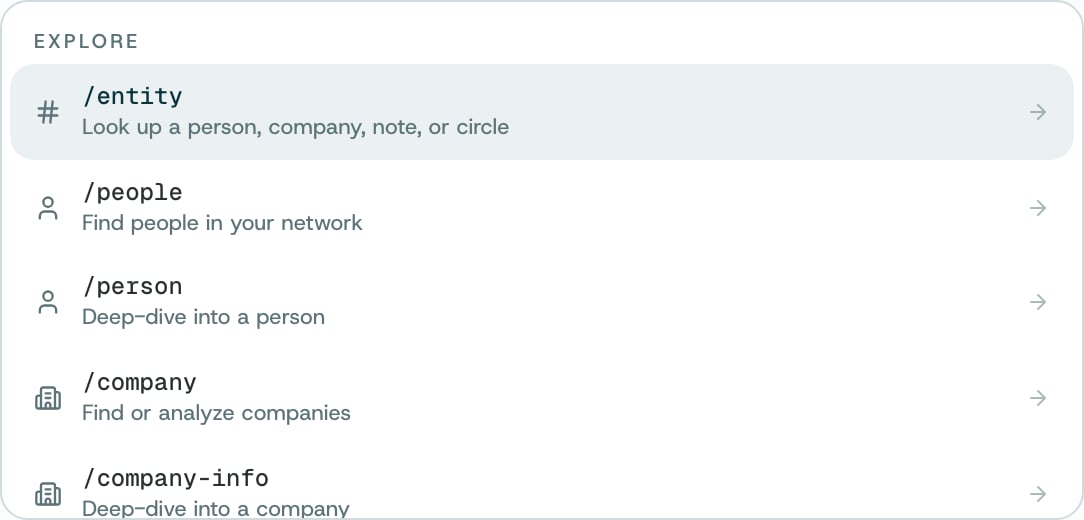
Type `/` to see the commands, grouped as Explore, Prepare, Organize, Automate and Open. A command tells O what kind of help you want, for example `/person` for a deep dive into one person or `/intro` to find a warm intro path. Every command is listed in [Ask O commands](/reference/ask-o-commands). You can always write in your own words instead.
## How to
Write what you want to know and what you are trying to do. A name, a little background or the outcome you want all help. For example: *Who in my network knows people at Northwind, and how do I know them?*
Mention people and companies with `@`, so O does not have to guess who you mean.
When an answer includes a list or a document, select it to open it beside the conversation. On a larger screen, drag the divider to give either side more room. Check important details before you rely on them.
Ask O to remember a follow-up: *Remind me to call Sarah tomorrow at 3pm.* Reminders appear in [Notifications → Reminders](/notifications-and-conversations/reminders).
Choose **New chat** for a different topic, or **History** to return to an earlier conversation.
Not sure what to ask? [The Ask O menu](/use-cases/index) has ready-made prompts for meetings, due diligence, warm introductions and more.
## Ask O to keep an eye on something
Tell O what to follow, in your own words:
> Keep an eye on Acme's launch.
O follows the topic and shares an update in O when there is new information. To stop:
> Stop tracking Acme's launch.
Updates need **Follow-up updates** turned on. See [Proactive follow-ups](/settings/chat#proactive-follow-ups).
## What O does behind it
* **It answers from your network.** O works with the people, companies, notes and sources you have connected or imported, and, if you choose to include them, networks that friends have shared with you.
* **It prepares; you decide.** Writing a draft does not send it to anyone. Whether and how you reach out is always your choice.
* **It can be wrong.** O can make mistakes. Check important facts, and the sources an answer gives, before you act on them.
**Availability and privacy.** O works with the information and features available to your account. Your conversations are listed under **History**, where you can delete any of them.
## Related
Every slash command and the keys that help you move around.
Use cases, with prompts ready to copy.
Ask O beside any page.
The sidebar, the page path and the top bar.
This documentation is built and hosted on [Mintlify](https://mintlify.com), a developer documentation platform.
 ## Start a specific job with /
Type `/` to see the commands, grouped as Explore, Prepare, Organize, Automate and Open. A command tells O what kind of help you want, for example `/person` for a deep dive into one person or `/intro` to find a warm intro path. Every command is listed in [Ask O commands](/reference/ask-o-commands). You can always write in your own words instead.
## Start a specific job with /
Type `/` to see the commands, grouped as Explore, Prepare, Organize, Automate and Open. A command tells O what kind of help you want, for example `/person` for a deep dive into one person or `/intro` to find a warm intro path. Every command is listed in [Ask O commands](/reference/ask-o-commands). You can always write in your own words instead.
 ## How to